What Does a Digital Marketing Specialist Actually Do Day to Day
Reading time: 14 minutes
Here’s a question that comes up constantly at career fairs, networking events, and family dinners: “So what do you actually do all day?” If you’re a digital marketing specialist, you’ve probably fumbled through some version of “I manage social media… and run ads… and track data… it’s kind of complicated.” And honestly? That answer, while frustratingly vague, is also completely understandable.
The role of a digital marketing specialist in 2026 is genuinely complex — part creative director, part data analyst, part strategist, part relationship manager. Unlike roles with narrowly defined outputs (a coder writes code, an accountant balances books), digital marketers operate across a sprawling ecosystem where the platforms, algorithms, and consumer behaviors are in a constant state of flux.
This article is your insider’s guide to what a typical day actually looks like, what skills are non-negotiable in 2026, how the role has evolved with AI integration, and what separates a good digital marketer from a truly great one. Whether you’re considering the career, just starting out, or managing someone in this role, let’s cut through the noise and get practical.
Table of Contents
- The Morning Routine: Data First, Coffee Second
- Core Responsibilities Broken Down
- How AI Has Transformed the Day-to-Day in 2026
- Real-World Scenarios: Two Days, Two Specialists
- The Digital Marketing Toolkit in 2026
- Common Challenges and How to Overcome Them
- Skills That Actually Matter Now
- Role Comparison: Digital Marketing Specialist vs. Related Roles
- FAQs
- Your Digital Marketing Mastery Roadmap
The Morning Routine: Data First, Coffee Second
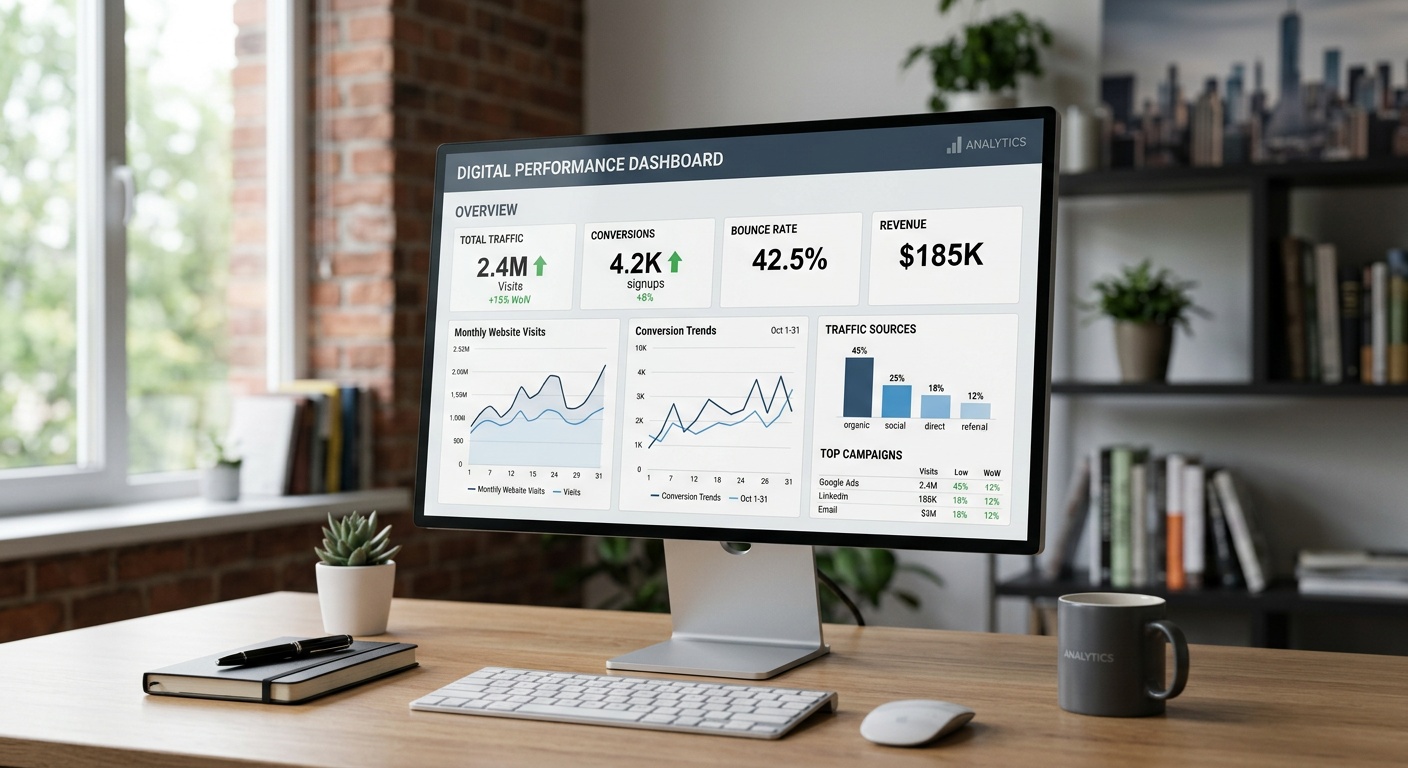
Most digital marketing specialists don’t start their day with creativity — they start it with numbers. By 8:30 AM, a typical specialist has already pulled up their analytics dashboards, scanned overnight campaign performance reports, and flagged any anomalies that need immediate attention.
Think of it this way: a paid ad campaign running across Google, Meta, and TikTok doesn’t sleep. By the time you clock in, thousands of impressions, clicks, and conversions have already happened — or haven’t. You need to know which, and why, before the marketing director’s 9 AM standup.
According to a 2025 HubSpot industry survey, 73% of digital marketing professionals reported spending the first 30-45 minutes of their workday reviewing performance metrics before touching any creative or strategic work. This data-first approach isn’t just professional discipline — it’s survival in an environment where a misconfigured ad can burn through a monthly budget in hours.
A Realistic Morning Checklist
- Review campaign dashboards — Check CPC, CTR, ROAS, and conversion rates across active campaigns
- Monitor SEO fluctuations — Look for ranking drops or traffic spikes using tools like Semrush or Ahrefs
- Scan social media mentions — Flag any trending conversations, complaints, or viral moments involving the brand
- Check email performance — Assess open rates, click-through rates, and unsubscribes from recent sends
- Review the content calendar — Confirm what’s scheduled to publish that day and whether it needs final approval
This isn’t busywork. Each of these activities directly informs decisions made throughout the rest of the day. Skipping the morning data review is the digital marketing equivalent of a pilot skipping pre-flight checks.
Core Responsibilities Broken Down
The job title “digital marketing specialist” is an umbrella that shelters a genuinely wide range of responsibilities. In smaller companies, one specialist handles everything. In enterprise environments, specialists tend to own one or two verticals deeply. Here’s the full landscape:
1. Search Engine Optimization (SEO)
SEO in 2026 has evolved dramatically from the keyword-stuffing era. With Google’s Search Generative Experience now serving AI-generated answers for a large percentage of queries, specialists must now optimize for Answer Engine Optimization (AEO) alongside traditional SEO. This means structuring content to be extracted and cited by AI systems, not just ranked in traditional blue-link results.
Day-to-day SEO tasks include conducting keyword gap analyses, building internal linking strategies, writing or reviewing optimized content briefs, and monitoring Core Web Vitals performance. A specialist might spend two to three hours a week on technical SEO audits alone, checking for crawl errors, duplicate content issues, and page speed problems.
2. Paid Advertising (PPC and Paid Social)
Managing paid campaigns is arguably the highest-stakes daily responsibility. A specialist overseeing a mid-sized e-commerce brand might manage $50,000 to $200,000 per month in ad spend across Google Shopping, Meta Advantage+, TikTok Ads, and YouTube. The margin for error is thin.
Daily paid advertising tasks include:
- Adjusting bid strategies based on performance data
- A/B testing ad creatives and headlines
- Monitoring audience overlap and frequency caps
- Reviewing automated AI bidding decisions (and overriding them when necessary)
- Building weekly performance reports for stakeholders
3. Content Marketing and Social Media
Content isn’t just blog posts anymore. In 2026, content marketing encompasses short-form video scripts, AI-assisted long-form articles, interactive tools, email sequences, podcast outlines, and LinkedIn thought leadership pieces. A specialist doesn’t necessarily create all of this themselves — but they’re usually responsible for the strategy, editorial calendar, and performance tracking behind it.
Social media management involves scheduling and publishing content, responding to community comments, monitoring competitor activity, and analyzing what formats and topics are driving engagement. The rise of platform-native AI tools (like Meta’s Advantage Creative and TikTok’s Symphony AI) means specialists now spend as much time directing AI creative as they do crafting it themselves.
4. Email Marketing and Marketing Automation
Despite being one of the oldest digital channels, email consistently delivers the highest ROI — Litmus reported an average ROI of $36 for every $1 spent in 2025. Specialists manage everything from segmentation strategy to A/B testing subject lines to mapping out automated nurture sequences for leads at different funnel stages.
How AI Has Transformed the Day-to-Day in 2026
Let’s address the elephant in the room: AI hasn’t replaced digital marketers — but it has fundamentally changed what they do with their time. According to the 2025 State of Marketing AI Report by Marketing AI Institute, 89% of marketing professionals now use AI tools daily, up from 52% in 2023.
The shift is best described as moving from execution to orchestration. Where a specialist in 2022 might have spent four hours writing a 2,000-word blog post, they now spend one hour briefing an AI tool, 30 minutes reviewing and editing the output, and use the remaining time on strategy, distribution planning, and performance analysis.
Here’s where AI has made the biggest functional difference in daily workflows:
- Content generation and ideation: Tools like Claude, ChatGPT, and Jasper handle first drafts, while specialists focus on brand voice, factual accuracy, and strategic alignment
- Predictive analytics: AI-powered platforms like Google’s Performance Max now predict which audience segments are most likely to convert before a campaign even launches
- Personalization at scale: Email platforms use AI to dynamically adjust content blocks, send times, and subject lines based on individual user behavior
- Ad creative optimization: Meta’s Advantage+ Creative automatically tests hundreds of creative combinations, with the specialist’s role being to set parameters and interpret results
- Competitive intelligence: AI tools now monitor competitor content strategies, ad creatives, and keyword movements in near real-time
Pro Tip: The specialists thriving in 2026 aren’t the ones who know every AI tool — they’re the ones who understand which decisions still require human judgment (brand voice, ethical considerations, crisis communications) and protect that territory fiercely.
Real-World Scenarios: Two Days, Two Specialists
Scenario A: Maya, In-House Specialist at a SaaS Company
Maya manages digital marketing for a B2B SaaS platform with 200 employees. Her day starts at 8:45 AM with a Slack message from the sales team — three enterprise leads that came in overnight from a LinkedIn campaign. She checks the attribution in HubSpot, confirms the campaign’s targeting was correctly configured, and forwards the lead details to the SDR team with context notes.
By 10 AM, she’s in a content strategy session with the product team, gathering feature update information to build into next month’s email nurture sequence. At noon, she reviews draft blog posts from a freelance writer, editing them to align with the company’s answer-engine optimization strategy. She checks whether key questions their ICP (Ideal Customer Profile) asks on Reddit and Quora are being addressed.
The afternoon is split between pulling a monthly performance deck for the CMO and launching a new retargeting campaign for users who visited the pricing page but didn’t convert. She tests three different ad copy angles before 5 PM and sets automated rules to pause the lowest-performing variant after 48 hours.
Scenario B: James, Agency Specialist Managing Multiple Clients
James works at a mid-sized digital agency and manages campaigns for six clients simultaneously — two e-commerce brands, one local services business, a nonprofit, and two B2B companies. His mornings are triage: who needs the most attention today based on overnight data?
One client’s Facebook campaign saw a 40% drop in ROAS overnight — he investigates, discovers Meta’s algorithm shifted budget heavily toward a poorly performing audience segment, adjusts the targeting parameters, and sends the client a brief update email before 9:30 AM. By midday, he’s on a client call presenting last month’s results using a performance report he built in Looker Studio. The afternoon involves writing two weeks of social captions for a retail client using an AI tool as a starting point, then heavily editing for brand voice before submitting for approval.
The contrast between Maya and James illustrates a fundamental truth: while the core disciplines are the same, the daily rhythm, client context, and pressure points differ significantly between in-house and agency environments.
The Digital Marketing Toolkit in 2026
A digital marketing specialist is only as effective as their tools. The landscape has consolidated somewhat in 2026, with a few dominant platforms per category and a growing stack of AI-native tools layered on top:
Time Allocation by Task (Average Digital Marketing Specialist, 2026)
Key platforms dominating the 2026 toolkit include Google Analytics 4, HubSpot, Semrush, Meta Ads Manager, Google Ads, Klaviyo, Hootsuite or Sprout Social, Looker Studio, Canva Pro, and AI tools like Claude or ChatGPT for content assistance. Most specialists are proficient in 8-12 platforms and deeply expert in 3-4.
Common Challenges and How to Overcome Them
The day-to-day reality of digital marketing isn’t all strategy and creative wins. There are genuine pressure points that specialists face regularly — and learning to navigate them is what separates the resilient from the burned out.
Challenge 1: Algorithm Changes Disrupting Performance Overnight
In early 2025, Google’s March core update significantly reduced organic traffic for thousands of websites, with some brands seeing 30-60% drops in a matter of days. Specialists who had diversified their traffic sources (paid, email, social, partnerships) were far better insulated than those who had put all their eggs in the SEO basket.
How to overcome it: Build a diversified channel mix before you need it. Audit your traffic source distribution quarterly. Ensure no single channel accounts for more than 60% of your total traffic or leads. Stay plugged into industry communities (Search Engine Land, Marketing Brew, SparkToro’s newsletter) so algorithm shifts hit your radar early.
Challenge 2: Proving ROI to Skeptical Stakeholders
Attribution is still one of the most frustrating challenges in digital marketing. A customer might discover your brand through a TikTok video, click a retargeting ad a week later, read three blog posts, then convert via a branded Google search. Which channel gets credit? Most attribution models oversimplify this journey, leading to internal debates about where to invest budget.
How to overcome it: Adopt a data-informed (not data-dictated) approach to attribution. Use a combination of first-touch, last-touch, and data-driven attribution models and triangulate across them. Invest in marketing mix modeling (MMM) if your budget is above $100K/month. More importantly, build stakeholder relationships on a foundation of business outcomes (revenue, pipeline, LTV) rather than channel-specific vanity metrics.
Challenge 3: Content Saturation and Standing Out
With AI dramatically lowering the cost of content production, the internet is flooded with generic, AI-generated content in 2026. Standing out requires genuine expertise, original research, distinctive brand voice, and formats that AI alone can’t replicate — such as real customer stories, proprietary data studies, and authentic video content.
How to overcome it: Conduct original research or surveys within your niche and publish the findings. Build content clusters around topics where your brand has genuine firsthand expertise. Invest in video content featuring real team members and customers — authenticity is increasingly the differentiator in a world of AI-generated sameness.
Skills That Actually Matter Now
Forget the endless list of “nice to have” skills you see on job boards. Here’s an honest look at what genuinely moves the needle in 2026:
- Data literacy: You don’t need to be a data scientist, but you absolutely must be comfortable building reports in GA4, interpreting statistical significance in A/B tests, and making budget decisions based on CPL and ROAS thresholds
- AI tool proficiency: Not just knowing what tools exist, but understanding their limitations — when AI output needs heavy editing, when it’s likely to hallucinate facts, and how to write effective prompts that produce usable results
- Conversion Rate Optimization (CRO) thinking: The instinct to ask “why isn’t this converting?” and the toolkit to investigate — heatmaps, session recordings, user surveys, and landing page experiments
- Strategic thinking: The ability to connect channel-level tactics to business-level goals, and to push back when a tactic doesn’t serve the strategy
- Written communication: Clear, persuasive writing for ads, emails, and stakeholder reports remains irreplaceable — even in an AI-assisted world
Role Comparison: Digital Marketing Specialist vs. Related Roles
| Dimension | Digital Marketing Specialist | Content Marketer | Growth Marketer | Marketing Manager |
|---|---|---|---|---|
| Primary Focus | Multi-channel execution & optimization | Content creation & editorial strategy | Acquisition & retention experiments | Team oversight & strategy |
| Data Orientation | High — daily metrics review | Medium — content performance tracking | Very High — experimentation-driven | High — strategic KPI focus |
| Creative Involvement | Medium — briefs and oversight | Very High — hands-on creation | Low-Medium — copy testing focus | Low — approvals and direction |
| Avg. Salary (US, 2026) | $68,000–$95,000 | $60,000–$85,000 | $80,000–$130,000 | $90,000–$140,000 |
| AI Impact Level | High — workflow transformed | Very High — creation assistance | High — predictive analytics | Medium — strategic planning tools |
Frequently Asked Questions
Is digital marketing a stressful job?
It can be, but the source of stress is often manageable with good systems. The main pressure points are budget accountability (watching ad spend perform in real time), algorithm volatility that can disrupt results overnight, and the constant demand to produce creative content while maintaining analytical rigor. Specialists in agency environments tend to face higher stress due to multi-client demands, while in-house roles typically offer more focused, strategic work. Building strong documentation habits, automating routine reporting, and setting realistic stakeholder expectations dramatically reduces day-to-day pressure.
How many hours a week does a digital marketing specialist typically work?
In most corporate environments, the role is a standard 40-45 hour workweek. However, during campaign launches, product releases, or seasonal peaks (Q4 for e-commerce, for example), 50-55 hour weeks are common. Agency roles often skew higher due to client demands. The good news: remote work flexibility is nearly universal in 2026 for this role — 78% of digital marketing positions listed in the US in early 2026 offered fully remote or hybrid arrangements, according to LinkedIn Workforce data.
Do you need a marketing degree to become a digital marketing specialist?
Increasingly, no — at least not as a hard requirement. In 2026, a significant number of hiring managers prioritize demonstrated skills (portfolio campaigns, certifications, measurable results) over formal degrees. Google, HubSpot, Meta, and Semrush all offer respected certifications that carry genuine weight. That said, a degree in marketing, communications, business, or even psychology provides a valuable strategic foundation. The most competitive candidates combine formal education or rigorous self-study with hands-on proof: a blog with real traffic, freelance client results, or a personal brand with measurable engagement.
Your Digital Marketing Mastery Roadmap: From Day One to Career Momentum
Here’s the straight talk: becoming genuinely excellent at digital marketing isn’t about consuming more content — it’s about strategic practice, honest measurement of your own results, and continuous adaptation. The field rewards the intellectually curious and the analytically grounded in equal measure.
Whether you’re stepping into your first specialist role next month or optimizing a team you already lead, here’s your actionable path forward:
- Audit your current skill gaps honestly. Map your proficiency across SEO, paid ads, email, content, and analytics. Rate yourself 1-5 on each. Your lowest score is your highest-priority learning area for the next 90 days.
- Build something real. Launch a personal project — a niche blog, a freelance client campaign, or a small e-commerce store — and market it with a real (even if small) budget. Failure and iteration here cost very little and teach enormously.
- Develop an attribution mindset. Practice connecting your marketing activities to business outcomes. Ask “how does this move the revenue needle?” for every tactic you deploy. This single habit separates tactical executors from strategic partners.
- Invest in one AI tool deeply. Rather than skimming a dozen AI tools, pick one that aligns with your primary channel and learn to use it at an expert level. Deep proficiency beats broad familiarity every time.
- Join a community and contribute actively. Platforms like Superpath (content marketing), PPC Hero (paid ads), and Women in Tech SEO offer peer learning that no course can replicate. Sharing your results — even early, imperfect ones — builds reputation and accelerates growth.
The broader trend shaping this career is unmistakable: as AI handles more of the execution layer, the premium on human judgment, strategic thinking, and brand authenticity will only grow. The digital marketers who will dominate in 2027 and beyond aren’t the ones who know the most tools — they’re the ones who ask the best questions, build the most trust with their audiences, and connect data to decisions with clarity and conviction.
So here’s your thought to carry forward: What’s one aspect of your current marketing approach that you’ve been running on autopilot — and what would change if you examined it with fresh, data-driven eyes starting tomorrow?

About the Author
